
(Parallels Between Rationing, Intentional Living, and Today’s Mindful Life)
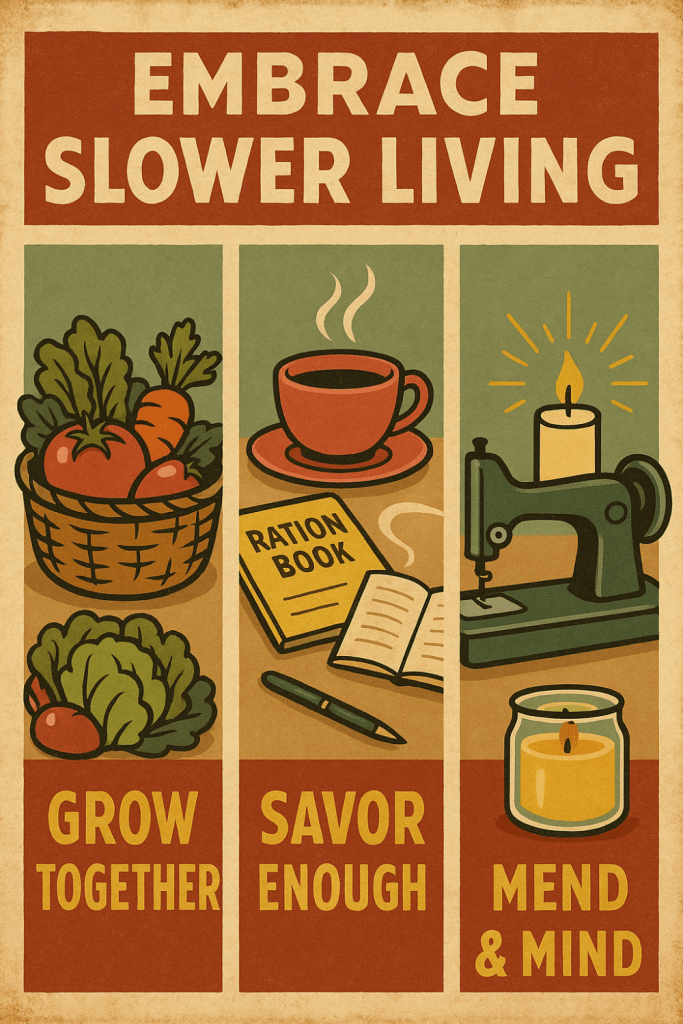
When we think of the year 1942, the images that often come to mind are black-and-white newsreels, posters urging citizens to “Do Your Part,” and the distant echoes of a world at war. Yet beyond the headlines and the global conflict, everyday people were quietly crafting a slower, more intentional way of living. Out of necessity, families simplified, adapted, and found meaning in the little things—lessons that feel surprisingly relevant to our own search for mindfulness today.
In many ways, the slower living movement of our time echoes the homefront life of the 1940s. While their world was shaped by ration books and Victory Gardens, ours is shaped by mindfulness journals and eco-conscious choices. Both share the same spirit: a longing to reconnect with essentials, to live within limits, and to find joy in what we already have.
Ration Books and Today’s Minimalism
In 1942, ration books became a part of daily life in the United States. Sugar, coffee, butter, meat, and gasoline were carefully allotted. Families learned to stretch what they had, substituting and reimagining meals. A single pound of sugar had to last weeks, so baking became more thoughtful, recipes creative, and waste unthinkable.
Today, while we’re not standing in line for ration stamps, we feel a similar pull to step away from excess. Minimalism, zero-waste living, and capsule wardrobes echo the wartime ethic of “Use it up, wear it out, make it do, or do without.” Where rationing once forced people to be intentional, many of us now choose it willingly—paring down clutter, choosing quality over quantity, and discovering that less often feels like more.
The similarity is striking: then and now, restraint became a doorway to freedom. In 1942, freedom meant supporting the war effort and caring for the home front. Today, it means reclaiming time, energy, and peace of mind from the overwhelm of consumer culture.
Victory Gardens and the Local Food Movement
By the spring of 1942, the call to plant Victory Gardens rang across America. Lawns, schoolyards, and vacant lots turned into rows of beans, carrots, and tomatoes. These gardens weren’t just about food security—they were symbols of resilience, self-reliance, and community spirit. Families found comfort in tending the soil, neighbors swapped seeds, and harvests nourished both body and soul.
Fast forward to today, and you’ll see raised beds on porches, balcony herb gardens, and bustling farmers markets. While no government is issuing us ration books, we’ve rediscovered the healing rhythm of growing our own food. Gardening is no longer only about survival—it’s about slowing down, reconnecting with nature, and savoring food that feels alive.
Just as a Victory Garden stood as a statement of hope during uncertain times, our gardens today serve as a declaration of mindful living. Whether it’s a single potted tomato on a city balcony or a backyard plot bursting with zucchini, each plant roots us in a tradition of slower, more meaningful nourishment.
Handmade, Mended, and Treasured
In 1942, a dress wasn’t purchased to wear once and discard. Clothing was an investment, cared for, mended, and passed down. Women patched socks, refashioned old garments, and knit sweaters for both loved ones and soldiers overseas.
This spirit of resourcefulness resonates today in the rise of slow fashion, thrifted treasures, and handmade goods. Many of us are rejecting “fast fashion” in favor of well-loved pieces that tell a story. A hand-knit shawl, a quilt stitched by a grandmother, or even a secondhand vintage dress carries with it the same sense of connection and intention that wartime homemakers practiced.
Choosing to mend instead of discard isn’t just about saving money—it’s about honoring the value of what we own, resisting the constant push to consume, and finding joy in creativity.
Slowing Down the Table
Meals in 1942 often looked humbler than what we consider normal today. Meat might be stretched into stews or casseroles with beans, potatoes, or lentils. Dessert was a rare treat, often sweetened with fruit or a touch of honey instead of sugar. Families gathered around the table not only to eat but to connect, to share stories, and to anchor themselves in a time of uncertainty.
Today, with meal-prep apps and grocery delivery at our fingertips, the temptation is to eat quickly and move on. Yet many of us long for the ritual of the 1940s table: sitting down together, offering gratitude, and savoring food slowly. When we practice mindful eating—paying attention to flavors, eating seasonally, choosing simple ingredients—we are, in many ways, mirroring the slower living of that era.
The wartime kitchen reminds us that food isn’t just fuel—it’s memory, comfort, and community.
Entertainment and Everyday Joy
In 1942, leisure wasn’t found in endless streaming services or online shopping. Families gathered around the radio for music, stories, and news. Children played board games, read library books, or joined in neighborhood baseball games. Evenings were slower, marked by conversation, crafts, or writing letters to loved ones far away.
Our version of slow entertainment today might be turning off the screen to knit, read, play a board game, or simply sit with a cup of tea. Just as wartime families found joy in the little things, we can rediscover the simple pleasures of conversation, creativity, and connection.
What 1942 teaches us is that joy doesn’t require extravagance. It often blooms in the smallest acts of togetherness.
Community Spirit and Shared Resilience
During World War II, community mattered deeply. Neighbors shared recipes, swapped garden produce, and looked after each other’s children. Scrap drives collected metal, rubber, and paper for the war effort. The spirit of “we’re all in this together” was more than a slogan—it was lived daily.
Our modern mindful living movement is also marked by community, though in different ways. From local co-ops to online forums about sustainable living, people gather to share tips, trade goods, and encourage each other. The parallels are striking: when times feel uncertain, we lean into each other for strength, support, and inspiration.
Lessons for Today’s Mindful Life
Looking back to 1942, what stands out isn’t only the sacrifices people made but the mindset they cultivated. They discovered that limits could lead to creativity, that simplicity could breed contentment, and that community could be as nourishing as food itself.
For us today, living mindfully doesn’t require ration books or blackout curtains. It requires intention. It means asking:
- Do I really need this, or am I buying out of habit?
- How can I repurpose or mend instead of replace?
- What can I grow, cook, or create with my own hands?
- How can I savor this meal, this moment, this day more deeply?
The answers will look different for each of us. But the spirit remains the same: a life of presence, gratitude, and enoughness.
Closing Thoughts
Slower living in 1942 was born out of necessity. Slower living today is born out of choice. Yet both are linked by a shared wisdom: when we pause, simplify, and live with intention, we not only endure but thrive.
As we navigate our own uncertain times, we can look back to that era not with nostalgia alone but with gratitude for the lessons it offers. The Victory Gardens, the mended clothes, the ration books, and the evenings by the radio whisper to us still: life is richest when it is lived simply, together, and with care.
Discover more from Naturing Relaxation
Subscribe to get the latest posts sent to your email.

 Naturing Relaxation